Monday, January 7, 2013

New Things


Constance Miller is a 25 year old woman with the sensibilities of a 65 year old woman and a fashion sense that her grandmother had once described as being “old-fashioned.” While she is, in fact, quite attractive, that seems to be a secret Constance is determined to keep to herself what with her adeptness at eye-averting and shoulder-slumping. Today she returns home from work with more urgency than usual, shutting the door with more force than the other tenants of her apartment building are used to hearing from her. She scurries towards the phone and quickly dials, whispering, “Please, pick up” as the other end rang. And then a click as someone answers.

“Hello, mom?” Constance hails.

“Connie?” her mother asks.

“I knew I shouldn’t have listened to you.”

“What is it, honey? Is something wrong?”

“You told me to try something new. I told you that I would only regret it but you insisted and you made me promise!” Constance had always been one to keep promises especially ones made to her mother.

“Are you okay?”

“I am now. But I can safely say I won’t be deviating from my- what did you call it?- my ‘ho-hum life’ anymore, at least not anytime soon.”

“What happened?”

“I’m devastated! That’s what happened! I’m never venturing out of my routine ever again after what happened today!!!”

“Honey, you’re being hysterical. Are you sure you’re okay? Do you need your father and me to come over?”

“Yes, mother, I’m sure I’m okay. And no, you don’t have to come over.”

“Now, just walk me through exactly what happened.”

“Well,” Constance stutters and takes a deep breath, “It was an unusual morning to start off with--” But it wasn’t an unusual morning at all. In fact, it was a very usual one, the type that Constance herself would approve of. The sun had very few clouds to compete with and the sky was a lovely faint blue as a result. It wasn’t too warm yet it wasn’t very cool either inviting Constance to enjoy her sensible breakfast that morning with the window open.

“Despite all that, I was in a good mood this morning,” she continues and she really was. “I finished my breakfast and got dressed for work.  I was running a few minutes late and briskly ran down the street to catch the next possible train.” Constance was actually a few minutes early when she walked calmly down the street. Granted, she may have felt some anxiety due to a concerted effort on her part to lift her head higher than usual and make actual eye contact with strangers (a stipulation of her promise with her mother).

“When I finally get to the subway station,” she continues, her mother listening intently, “I had just missed the train. It was just pulling out as I got off the last step.” While there was a train that was pulling out of the station as Constance got off the stairs, it was most definitely not her train. “The droves of people that the train brought were enough to make me feel claustrophobic.  They were in such a hurry to go this way and that way that I nearly lost my bearings. And just as quickly as they had arrived, everyone disappeared.” There were a few people that got off the train, but none were in too much of a hurry. Only half of them leisurely walked up the stairs to the street and the rest of them remained on the platform waiting to transfer to the next train.

“That sounds quite jarring, Connie,” her mother responds. “I don’t know how you could stand living in the city for so long. You tend not to do so well in crowded places.”

“Mother, that’s not even the worst of it. The worst part about waiting for your train in an empty station is the silence. Even the smallest rustle of litter is cacophonous. I nearly jumped when I heard the buzzing of one of the neon lights. It took me a split second to realize it was just the lights flickering.” The noise of city life is deafening compared to the kind of quiet that one may experience in subway stations. However, Constance normally loved the lack of noise on that particular platform, a stark contrast from the din of the city above. But the flickering of lights drew her attention to a man sitting on a bench on the far end of the platform.

“Connie, when exactly is the part where you try something new?”

“I’m getting to that, mother! Where was I? Oh, yes, the lights were buzzing and blinking away. Just one particular set of lights and sitting on a bench just below them was an otherwise unassuming man.” He was a handsome man with a strong jaw, thick black hair, and he was wearing a very stylish suit. “He looked lonely.” In actuality, he looked as if he were sleepy. His head hung down, his eyes were closed and his hands rested neatly on his lap. In fact, if the man were awake then, Constance’s shyness would have overcome her ability to keep her promise to her mother.

“So this was the new thing you were going to try, Connie? You were going to ask out a boy?”

“I wasn’t going to ask out a boy, mother! I just wanted to start a conversation!” It’s difficult to start a conversation who was likely taking a nap. Constance was too afraid to wake him let alone talk to him and opted to sit beside him hoping to be that Good Samaritan that woke him up in time to catch his train. She hoped against hope that that would be enough for this good looking stranger to start a conversation with her rather than the other way around.

“Well, what happened?” her mother inquires with noticeable enthusiasm.

“As I approached him the lights went completely out. It startled me, of course, and it actually caused me to jump.” The lights went out but Constance didn’t jump. In fact, she breathed a sigh of relief as it was an excuse to stall any sort of contact with the attractive man who sat just a few feet away from her. But as she stood up from the bench to look at the flickering light, she noticed something. “And when I jumped I saw his hands fall lifelessly to his side. I scooted closer to him and… and…”

“Honey, what is it?”

“I noticed there was blood on his shirt. It wasn’t spewing out like those horrible horror movies that are on television. There was a large spot of blood on his shirt that was just barely hidden by his jacket. I wouldn’t have noticed it right away if his hand hadn’t had moved. I gently touched his shoulder to ask him if he was okay, if he needed me to call for an ambulance or something… and then…. And then….”

“Oh, my goodness, Connie!”

“And then he slumped over lifelessly off of the bench. His head hit the ground with a dull, sickening thud and all I could do was scream at the top of my lungs!”

“What happened to him?”

“I don’t know! One of the passersby must have heard me scream and called a police officer. It all went by so fast. I gave my statement to the police just as I told you just now.” Well, the account she gave police was much closer to the truth than the one she had just given to her mother.

“Oh, sweetie, I’m so sorry. Are you sure you’re okay?”

“I am… Thanks… But the whole ordeal was very traumatic. I don’t think I’ll ever try anything new ever again.”

“I’m so sorry you had to go through that, honey. I hope you really don’t mean what you said about trying new things. I just think that trying new things would give you a new perspective on life.” Connie’s mother implores.

“Well,” the young woman replies, “maybe one day I’ll try something new again. But for now I’m perfectly content with the way things are. Anyway, I have to start preparing my dinner and make sure I get to work early tomorrow morning. I’d hate to have another horrendous morning twice in a row.”

“Okay, honey. I’m so glad you’re doing so well after that ordeal. Goodbye. And sleep well.”

“Bye, mother. I’ll see you when I come over this weekend.”

To this day, Constance Miller would deny that that first venture into new things changed her perspective on life. But she would be wrong whether she admitted it or not. Because even though she did actually prepare dinner as soon as she hung up the phone, she didn’t go straight to bed as originally intended. Instead, she took out a pen and a pad of paper and recounted the events one more time in her head and realized that the events of that morning had awoken in her a penchant for writing fiction. It was a hobby that soon developed into a talent but wasn’t fully realized until quite some time after that initial incident. But even if she hadn’t discovered this ability to write, her life would still be changed drastically since it takes at least three times longer to get to her office by bus than by subway.

Sunday, December 23, 2012

Winter


Benjamin took a rag and folded it neatly in half to wipe down the mirror which his shower had fogged up. This would be his third and final attempt to get his necktie just right. When he got the tie adjusted to his very particular liking, he stood back and looked at himself in the mirror. To any other observer, this man with marginally good looks had groomed himself for what could have been a job interview. He picked up the comb and carefully dragged it once down the right side of his head, then twice on the left. Sufficiently satisfied that every hair was perfectly in place he smiled at himself in the mirror. It was such a subtle curl of his lips that the smile was practically imperceptible to anyone but him. He shut the lights as he exited the bathroom.

The fireplace had been going for sometime leaving the rest of the house warm and smelling of a forest of beech trees. Benjamin walked over to the kitchen and checked on the food one more time to make sure all was in order. The roast was partly done, ready to be brought up to the perfect doneness at the perfect time. The sauce was heated to just the right temperature. Glasses and drinks were chilled and the desert was all but put together. Constructing the desert is going to be the most fun part of the meal, Benjamin told himself. Walking over to the dining table, he made miniscule adjustments to the flatware and silverware when he noticed a harsh glare coming off his dish.

Not wanting to have to go through the trouble of changing the dish, Benjamin turned off the lights over the dining table. It made it too dark to see anything on the plate come dinner time so he went digging in the pantry where he kept candles handy in the event of a power outage. He set two candles in candleholders and put them on the center of the table. He rummaged through one of the kitchen drawers and pulled out an old book of matches to light the candles. They had never been lit so it took some time to melt the thin layer of wax on the stiff wick before the flame found its balance atop each candle. The entire house was bathed in the warm, soft light of the candles and fireplace. Another smile briefly flashed on Benjamin’s face.

Though he wouldn’t consider himself much of a drinker, Benjamin believed that, in moderation, the occasional scotch would ease the anxiety that came with this particular time of year. Admittedly, he felt that the sparse drinking he did made him appreciate the flavor even more. He poured himself a drink and as he took a modest sip felt the gold liquid heat his gullet all the way down to his empty stomach. The clock indicated that it was early yet to make final preparations for dinner so he walked over to the window to admire the gentle snowfall. The only cars in the street outside were parked along the street allowing the entire area to be blanketed with snow. Then there was a rustle just out of his view.

It was the shouts of children running the quiet street. Maybe they yelled to be heard through the layers that protected their rosy cheeks from the cold or maybe because it was just fun, Benjamin would never know. A woman, presumably their mother, and the oldest of the children carried wrapped boxes in both hands. The mother could barely see over her parcels, the child could barely keep them from touching the ground. The other children, much younger, squatted to the ground on the lookout for one another as they packed the snow into uneven spheres to chuck at each other playfully until the mother scolded them for falling behind. They laughed and caught up with the rest of the family, still throwing the snowballs at each other.

Benjamin grew up on the west coast. There were no such things as snow days and white Christmases for any of the children of his neighborhood where most rites of passages were summertime rituals. But even then, young Benjamin (or “Ben” as he was known then) wasn’t usually found with other children. Most of the friends he made were either one of the many adults who helped raise him or one of the few children he had grown up with who had all moved away before Ben had started junior high. He never found them again but a piece of him wishes he had put just a little more effort into looking. Instead he nurses his drink and watches the small footprints retrace the steps of a childhood he had never known.

RING! The phone screeched jolting Benjamin out of his fit of nostalgia. He quickly made his way to the phone and laid the glass of scotch beside it as he picked up the receiver.

“Hello?” he answered, “Oh! Hello! Are you on your--”

Only Benjamin was able to hear the other half of the conversation.

“Oh… I see,” he responded. “I see.”

His words, along with his breath, slowed with each subsequent sentence.

“No, not at all! That’s entirely ok,” He seemed to lose gusto with each passing second he was on the phone. 

“Yeah, no… I didn’t… I didn’t go through any trouble at all.”

There was a beat followed by a hushed click on the other end of the phone. The receiver seemed to grow heavier in Benjamin’s hand as he finally hung up. He slowly took in a deep breath before drinking the rest of his scotch and clearing the table of unused dishes and silverware. Blowing out the candles he took them to the kitchen counter leaving a delicate trail of smoke behind him. The sauce was taken off the stovetop, the roast out of the oven and the fate of the desert was uncertain as he shut off the kitchen lights. His shoulders seemed to grow heavier than the receiver as he made his way to the fireplace to turn off the gas.

It wasn’t until he stepped away from the heat of the dying fire on the hearth that he realized how clammy his palms had become, how hard his heart was beating. He didn’t even know that he had loosened his tie in a messy knot hanging off his neck by several inches. His feet dragged the rest of him to the window. The streets were emptier than before with all their lonely corners filled with even more snow. All the children’s footprints were buried underneath it all, visible only to Benjamin if he really looked for it. Tired of trying to retrace that snowball fight, he pulled the curtains shut and meticulously tugged on them to ensure that the pleats were exactly where they were supposed to be.

“The scotch must be getting to me,” he thought to himself as he wandered into the bedroom. He took off his tie and folded it, laying it neatly on the dresser by his bed. The door shut behind him but no one would ever know that this year Benjamin would spend Christmas alone.

Some time passed and the wind howled for a bit before dying down leaving several inches of snow outside burying those children’s footprints for good. Had this been another moment of another day of another part of the year when the snow and ice encased the lonely outside in its pristine shell, it would have been easy for Benjamin to spend the rest of the night bundled up in bed, insulated by so many reasons to stay inside. But it was Christmas and he found himself feeling uncharacteristically spontaneous. Just outside his house, he built a snowman with the craftsmanship of a small child and he couldn’t be happier with it. He smiled his largest smile of the day, proud of the new friend he had built himself. Looking around to see if anyone was watching he squatted down to compact a bunch of snow into a ball and threw it up into air letting it hit him with great gusto. He brushed the flecks of ice off his hair as he walked back inside, admiring the patterns his footprints left in the snow.

Tuesday, July 17, 2012

Fifty Years of Amazing


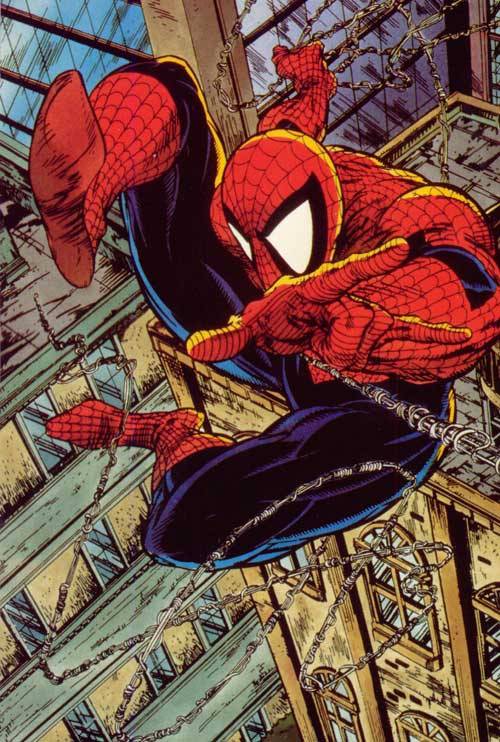
Spider-man art by Todd McFarlane

In 1962, comic book readers were teenaged baby-boomers ready to head out into a world they believed could be changed for the better. The superheroes of the day were difficult to relate to, many of them adults contributing to society. They were accomplished scientists, billionaires, gods, and a super-soldier who punched Hitler. The few teenagers in comics were either being rescued or were sidekicks in the mythic shadows of their mentors. Even then, none could truly capture the awkwardness of high school adolescence. In August of that year, however, Amazing Fantasy released its fifteenth and final issue introducing the world to a shy high school kid from Queens who was about to learn that with great power must also come--  great responsibility.

Growing up in the eighties, television reruns introduced me to the world of Spider-man. The campy theme song of the 1967 Spider-man cartoon is persistently conjured up whenever I see the webhead. Spider-man and his Amazing Friends introduced me not only to Iceman and then newcomer Firestar, but to other heroes and villains in the Marvel Universe. I remember watching the 1977 live-action Amazing Spider-man along with the character’s appearances on The Electric Company where he even fought Dracula (aptly portrayed by Morgan Freeman). That would not be the unlikely matchup’s only television appearance as they would square off in the 1981 Spider-man cartoon. But I wasn’t introduced into the comic book world of the webhead until the tender age of six.

The first Spidey comic I read was Amazing Spider-man #300 where a darker (literally and figuratively) Spider-man soared over New York and off the cover as only Todd MacFarlane could have created. Writer David Michelinie introduced the origin of Venom who would quickly become my favorite Spidey villain. Going from the television version of Spider-man to the comic book is a jarring experience when you realize how much death surrounds Peter Parker. Everyone knows how integral a role the death of Spider-man’s uncle, Ben Parker, played in turning the mousy teenager into a legendary hero. But it would not be the only death to shape Spidey’s heroic journey.

Stan Lee’s Amazing Spider-man #90 (1970) showcased a battle between the wall-crawler and Doctor Octopus that sent debris crashing towards the street. NYPD captain, George Stacy, sacrificed his own life to save a boy from being crushed. His last words begged Spider-man to be good to his daughter, Gwen, who was Peter’s girlfriend implying that Captain Stacy had deduced Spidey’s identity. Little did Spider-man know how those words would haunt him just three years later.  Gerry Conway’s The Night Gwen Stacy Died (1973) would not only shock the comic book community but signify an end to the Silver Age of comics, that innocent era in which the superhero always saved the day. It was in his darkest hours that Spider-man showed us how very human he still was, and how very heroic he could be.

What shaped Spider-man into a superhero was the group of people he cared about. In Amazing Spider-man #31 (1965) Steve Ditko illustrated his prowess as a storyteller through artwork. The hallmark of this issue is a scene originally intended to be only a few panels, which Spider-man is trapped under a large piece of machinery. The wall-crawler was all but defeated until memories of his loved ones motivated him to summon the last of his strength to escape. Stan Lee even noted that the scene got him cheering.

As the character grew older and donned the black suit in 1984, the line between good and evil blurred. Peter David explored that very theme in the classic arc, The Death of Jean DeWolff (1985). The opening pages alone are worthy of legendary status in which Jean DeWolff reminisces about her past until she hears a thumping at her door that turned out to be police officers who would find her dead from a shotgun blast. What unfolded afterwards was a gritty noir-like whodunit in which Spider-man explores the darker side of having great power. The darker storylines continued in 1987 with J.M. DeMatteis’ classic storyline, Kraven’s Last Hunt (1987). Kraven the Hunter loses his grip on reality obsessed with his past defeats against the wall-crawler. He buries Spider-man alive and captures Vermin, a villain who had recently defeated the superhero. Convinced that he is Spider-man’s superior, Kraven ends his life believing there is nothing left to pursue. Dealing with themes of mortality and moral ambiguity, Kraven’s Last Hunt illustrates that Spider-man is not simply childish adventure stories. One would think that with all the angst that comes with crime-fighting, Spider-man would have quit some time ago.

Tired of being unappreciated, Stan Lee has Peter Parker retire in Amazing Spider-man #50 entitled Spider-man No More (1967). The art by John Romita is iconic; one panel inspiring a scene in Spider-man 2. The memorable cover shows Spidey with his back turned to the reader and a dejected Peter Parker emerging from the horizon. In the web-crawler’s absence, crime rose with the emergence of a new Kingpin of crime (Wilson Fisk’s first appearance). Peter returns to crime-fighting after a mugging victim reminds him of Uncle Ben. But sometimes it takes something even simpler to remind the wall-crawler why he decided to become a superhero.

With a desire to write a human interest story, Roger Stern created The Kid Who Collects Spider-man for Amazing Spider-man #248 (1984). While a majority of the issue spotlights Spider-man’s fight with Thunderball, it is remembered for the wall-crawler’s visit to young Timothy Hammond. Peter Parker tells the boy his amazing origins and reveals his secret identity. The surprisingly emotional twist in the final page is so memorable that I dare not spoil it here. However, I will say that it inspired an emotional episode of the 1994 Spider-man animated series.

As a twelve-year-old, Saturday morning cartoons were that prize I woke up to after enduring an entire week of school. The creators of the show were not afraid to trade in campy stories for darker ones truer to the comics. As a Spider-man fan, I thought things could not get any better until 2002 when Sam Raimi finally brought Spider-man to the big screen with a record-breaking trilogy. A year after the third movie was released, the short-lived Spectacular Spider-man would debut and become an instant cult classic, and arguably the best animated version of the webhead thus far in this fanboy’s opinion mixing elements of the classic origin with the new Ultimate storyline.

Marvel launched Ultimate Spider-man in 2000 making the mythology more accessible to a newer, younger audience. Brian Michael Bendis and Mark Bagley manage to bring a teenage Peter Parker into the 21st century without losing the charm of the Lee and Ditko’s version. Death of Spider-man (2011) features a battered Peter Parker who meets his demise while protecting those he loved from the Green Goblin. Spider-man had saved Aunt May the way he couldn’t save his Uncle Ben, declaring it triumphantly with his last words. The events overlapped with the introduction of the new Ultimate Spider-man, Miles Morales, whose innocence and naiveté echo the charm of his predecessor.

Stan Lee placed Spider-man in New York City to make it feel as if he could exist in the real world. The events of September 11 left the country in need of heroes. Marvel asked J.M. Straczynski to write their response to the national tragedy for Amazing Spider-man #36. The cover was entirely black in commemoration of the lives lost that day and while the issue shared its fair share of criticisms, the artwork by John Romita Jr. is what stands out. For me, one of the strongest comic book images in recent memory was the panel of Spider-man holding back a crying boy reaching to his father, a fallen New York firefighter. The issue portrayed Marvel characters unifying to honor the real-life heroes of 9/11. Spider-man was not a superhero then, but a New Yorker doing his part to cope with tragedy.

Peter Parker doesn’t have a billionaire genius’ swagger or a blind lawyer’s charm. He isn’t a god of Asgard, a mutant born with powers, nor is he a hulk of any color. He’s an unassuming kid from Queens with a penchant for science, always at the wrong place at the wrong time. Maybe I am a fan of Spider-man because I was the quiet kid, my nose always buried in a book. Or maybe it’s because my relationship with my grandmother mirrored Peter’s relationship to Aunt May. The point is that Spider-man was the first relatable superhero. Anybody can picture themselves underneath that mask regardless of their race, creed, or even gender swinging from rooftop to rooftop with a “thwip” of the wrists. Spider-man made his mark in television, the big screen, and even Broadway. And with the latest re-imagining of the film franchise premiering earlier this year, there is no doubt that your friendly neighborhood Spider-man is here to stay. Here’s to fifty more “Amazing” years!

Wednesday, July 20, 2011

When It All Changed


Kids’ stuff. That’s what everyone called comic books. For decades, they were mere escape stories printed on cheap paper sold to young children scared of the new urban landscape. It was a far cry from what Will Eisner envisioned due, in large part, to the efforts of the Senate Subcommittee on Juvenile Delinquency and Dr. Frederic Wertham in 1954. Shortly thereafter, the Comics Code Authority was formed as an attempt for the industry to police itself. As a result, genres such as horror, crime stories, and other pulp fiction disappeared from comic book shelves and according to Frank Miller, “the basic idea of ‘superheroes’ was made impossible by putting it in a world where it didn’t need any.”

Twenty five years ago, nuclear war between the United States and the Soviet Union seemed to be the only conclusion to the Cold War. Economic disparity ripped this country apart at the seams, favoring few and punishing the rest. With the emergence of crack cocaine, the stage was set for the U.S. to experience its highest crime rates in history. It seemed we needed superheroes once again. But in 1986 a new breed of comics refused to let us escape and instead held a mirror up to the gritty reality that we lived in. The door would be violently kicked open for subsequent writers to elevate this “kids’ stuff” to a true art form.

From 1966 to 1986 Adam West defined the caped crusader for a generation in the live action series, Super Friends, and the occasional Scooby Doo cameo. It was a fun version of Batman but it was a Batman without a past. In The Dark Knight Returns, Frank Miller not only reminded everyone what tragedy would spur on a young boy to strike fear in the heart of Gotham’s criminals, but what drove a 55-year-old Bruce Wayne to don the cape and cowl once more. With a few panels, no words, and barely any color, one of the most famous scenes in Miller’s masterpiece reminded the world what forever changed Bruce Wayne: the brutal death of his parents.

Frank Miller, a master of pacing, created a story that was akin to watching movies rather than reading comics. Thomas and Martha Wayne’s murders unfolded as if it were in slow motion. Shadows dominated the dramatic scenes displaying the influence that film noir had on Miller’s work. But it’s the hard hitting, wise cracking prose that tied everything together and would later become his signature style. The Dark Knight Returns would also be the first series that DC would publish on prestige format. The cover was heavier stock, the paper was literally shiny and new, and it would be a few pages longer than the average comic book. But most importantly, it told the story that Miller wanted to tell.

Not only does Miller pit the Dark Knight against authoritative figures but examines how a masked vigilante would affect the city he’s meant to protect. Wannabes followed in Batman’s footsteps, sometimes ending in violent death; an element that Christopher Nolan put in The Dark Knight. This negative attention is magnified a hundredfold by the media more interested in projecting opinions as opposed to delivering facts. Whether it was a gang called The Mutants, the police, or even Superman acting on behalf of the U.S. government nothing would stand in Batman’s way to bring order to his city. While The Dark Knight Returns resurrected the world’s greatest detective, Watchmen decidedly sought to deconstruct the genre all together.

In a world threatened by nuclear fallout, it only seemed logical to have heroes face the same problems we did. But Alan Moore and Dave Gibbons took it a step further and argued we would ultimately end up in the same place. All the characters of Watchmen were still, at their very core, human; all at once fragile and alone. Rorschach and the Comedian were sociopaths, Sally Jupiter was an exhibitionist, Dan and Laurie sought the approval of their parental figures, but all of them walked down the same self-destructive path. These adventurers set out to save the world, but they could barely save themselves.

At first glance, Watchmen is a simple mystery complete with colorful characters, red herrings, and a detective in a worn fedora. But the intricate plot served not just to keep the readers’ interest but fleshed out each character and the universe they lived in. Every word and image is filled with details that are only truly appreciated after multiple readings. The attention to detail on both Moore and Gibbons’ part is what helped create this world that is so different yet vaguely similar to ours. Not many comics, even to this day, can boast to have references from Bob Dylan and Carl Jung and still tie them all together to a single theme.

Alan Moore once said that “if you’re talking about superheroes, it’s very likely to be a meditation on power.” The most powerful character was Dr. Manhattan’s power won the Vietnam War in two months but drifted him further from his own humanity. The smartest man in the world, Ozymandias, sought to save the world by destroying it. Rorschach’s refusal to compromise “even in the face of Armageddon” solved the murder mystery but led to his demise.

With all the death and violence it would be easy to say it was a dark ending. But it does offer a glimmer of hope. It was a lowly intern named Seymour who (possibly) brought the truth to the world. Looking at the story as a whole, from Adrian’s grand scheme to the Tales of the Black Freighter to the very last panel of the novel it seems that, good or bad, the lesson lies in the fact that the fate of this world is “entirely in [our] hands.” Because superheroes dominated the landscape, it seemed there was little left to explore once Watchmen had thoroughly deconstructed the genre.

In stark contrast to The Dark Knight Returns and Watchmen, Maus was a personal story dealing with not only the struggle of a man to survive the ordeals of the Holocaust but an introspective look at Art Spiegelman’s relationship with his curmudgeon father, Vladek. Originally published as a short comic strip in 1972, Spiegelman would create a longer version of the story; Volume I of this version was published in 1986.

Alan Moore once referred to Art Spiegelman as “the single most important comic creator working within the field” and it is little wonder why. Despite working in only black and white, certain images seem to pop out and stay with you such as a road crossing in the shape of a swastika or people going insane on the train to Auschwitz. At first glance, the story seems to meander in every direction offering no real solution to hate. Vladek, even as a Holocaust survivor, still has racist tendencies. Even Spiegelman himself confesses, “It wasn’t to make the world a better place by explaining the Holocaust to anyone but to me.” By the end of the story, Art knows his father a great deal better and Vladek was even reunited with his wife, Anja. War can bruise and scar humanity but even if our future looks bleak we still have family and friends to lean on.

With the art form taking shape there were few avenues for new artists to burst onto the scene. The powerhouses that controlled much of the market were DC and Marvel, both of which were difficult to get one’s proverbial foot in. However, in 1986, a comic book store owner from Portland, Oregon named Mike Richardson decided to offer a new platform for amateur writers and artists to tell their stories. Dark Horse Comics was born. Ushering in new characters like Concrete, Usagi Yojimbo, The Goon, Hellboy, and the riffraff of Sin City, Dark Horse gave artists more creative freedom. Today, Dark Horse continues its legacy as one of the largest companies still accepting submissions from amateur writers and artists. Along with being the leading publisher of licensed comics, Dark Horse also publishes Star Wars and Buffy the Vampire Slayer stories to name a few.

There would be no war. The Berlin wall was torn down, Communism fell, and the threat of self destruction faded with the end of the decade. Comics were not responsible for ending that anguish and heartbreak but they did offer us a new perspective of our reality. It was heartbreak and as Will Eisner once said, “You can’t talk about heartbreak to a kid.” The Dark Knight Returns, Watchmen, and Maus told stories we could relate to. That is what true art should be able to do; to put up a mirror so that reality can make just a bit more sense. Nobody was able to predict what a banner year 1986 was going to be for comic books. Maybe it was tachyon interference. But one thing is for certain, twenty five years ago, comics grew up and they haven’t looked back since.

Monday, July 11, 2011

You Know Who You Are

I'd like to think that there is only one person reading this at this very moment on this very day. You know who you are. This day is very important to you and you already know why. I'm sure that even if we were still speaking with each other, chances are that you still wouldn't be here reading these very words. So maybe this is more for my benefit than it is yours. But I don't see any other way of letting you know that I'm still here... That is, if I'm needed. Maybe it's naivete or narcissism on my part, or maybe I'm just too goddamned lonely to let it go but.

There's a small albeit vocal part of me that's yearning to do whatever is necessary to forget that part of my life. That part with you in it that's, all at once, frustrating and exhilarating and familiar and new. But who am I kidding? I meant every word when I said I'm a better person for knowing you. I have no idea why I was a part of your life. That still confuses the hell out of me. I never questioned it mainly out of fear of jinxing the good thing we had going.

Moments when we were on the exact same page were rare but I treasured each and every one of them. Even then, however, I knew and possibly even you knew that I would never exceed that number two spot. There would always be that one person's shadow that I would be trying to crawl out of and we both know whose enormous shadow that is. I couldn't help but notice that all my better qualities that you enjoyed reminded you of the owner of said shadow. I let it slip, but it killed me whenever you made the comparison.

On the off-chance that you're reading this, I hope you take it easy today. For the most part, I'm putting this out there, not really expecting that you'd stumble upon this. Not that it'll happen, but vous êtes plus que l'accueil pour me contacter si vous voulez parler. Autrement, j'espère que tout est bien. Au revoir et j'adore.

Saturday, March 19, 2011

2010: Best. Year. Ever.

“Don’t it always seem to go that you don’t know what you’ve got ‘til it’s gone,” Joni Mitchell once wrote. A quarter of this year has come and gone. And what better time to post a review of the best year that I have had in the 28-plus years I have been on this planet so far? Why is that, you ask? Let me count the ways. But I think it’s a good idea if I start at the beginning.

When the countdown reached zero, a cacophony of joyous screams and plastic horns welcomed 2010. The sky was instantly ablaze with fireworks. Greens and reds and purples and yellows streaked across the velvet sky leaving faint starburst imprints of smoke. The faint smell of gunpowder crept through the air. That’s one great way to start off the year: at the Happiest Place on Earth. Well, technically a couple of yards outside of it. Disneyland sold out much earlier than I thought it would so the family and I got into California Adventure, but on the upside got free day passes to Disneyland valid at anytime in 2010 (which we would later use to spend my Dad’s birthday). I’ll be honest; I had low expectations spending the New Year with family, but ended up having a blast. The booze and smoked turkey legs helped a tad.

When Jaaaaaaa met L. A.

I remember a few years ago, I felt down for no particular reason. It was just one of those bad days where I was tired of feeling so damned lonely. It had gotten to the point where I couldn’t go to sleep. Normally, I’d put on music until I felt better or started to feel drowsy but nothing was working the way it usually did. To remedy the situation I decided to bring on the big guns and was about to play some Beach Boys. Brian Wilson’s mastery of harmonies tends to calm me down, but I had the urge to hear something different. That was when I turned to YouTube to find covers of God Only Knows. It may seem shallow, but I clicked on the still with the cute blonde girl playing the ukulele. I mean, who wouldn’t? I found myself listening to all her covers and the few originals that she posted. What can I say? I was in love.

Her name is Julia Nunes and she’s gained a whole lot more recognition since then with a dedicated fan base. Being the nerd that I am, I decided to send her some fan love in the form of a comic strip, which she later featured on her cover of the Beatles’ All My Loving. Suffice it to say that should I ever need to put a smile on her face, I can always put one of Julia’s videos on. Fast-forward to January 14, 2011 where she would play a gig at The Echo in Echo Park. It’s a small venue where a seedy part of town meets a hipster part of town. She performed. We, the fans, were entertained. And there was mingling afterwards. When I told her who I was, she actually referred to me as “that guy.” Good times, indeed. She’s as sweet, nice, and cute in real life as she is on the computer monitor. I’d later see her again when she was back in L.A. for VidCon. And yes, it was just as awesome.

Don’t tell me what I can’t do!

I realize that I never gave myself closure as far as my LOST mission. The mission was a fail, but in no way would I consider it, in any way, a failure. I got two (technically one and a half) autographs from the show’s cast. The first was Jorge Garcia who was kind enough to lend his help in getting others to sign the poster. Of course it wouldn’t be characteristic of my life if it went on from there and ended the way it should have. I misread ONE word in the letter that Jorge sent back with my poster, which TOTALLY changed what he was trying to tell me. And like an idiot, I posted what I misinterpreted on the internet and was thusly grilled by not only the new protector of the island, but by a slew of random people as well. Those were not fun times. I posted an open apology to Jorge Garcia and while he never formally accepted said apology, his posts in which he gave me a deserved scolding were deleted. His other posts were left as is. That’s good enough for me.

The second autograph should only count as half since it wasn’t on the poster itself. When I saw that Harold Perrineau had a facebook account, I definitely had to add him. Did you know that he is as talented a singer as he is an actor? He’s not one of those performers that go on stage for the sole purpose of being the center of attention. He genuinely seems to be having fun up there and loves nothing more than to see the audience having a good time as well. How do I know this? Well, he performed at the Universal CityWalk and I went there to see him. I bought one of his CD’s, which he signed. It’s not exactly an autograph on the poster, but it’s an autograph nonetheless and that’s good enough for me.

I’ve got a dog. His name is Jack and though he wasn’t named after Dr. Shephard he does play a bit part in this mission. I walk him at around the same time, pretty much every day. And while I never grew the cojones to walk up to Sam Anderson and ask for his autograph, he does on occasion bump into Jack and me. It’s funny, you’d never associate a man who courteously smiles and greets a random guy walking his dog in the afternoon with an actor whose résumé is as long as Sam Anderson’s. So I didn’t get his autograph at all, but a friendly nod in my direction is good enough for me.


Now, I know the initial stage of my mission was to find four cast members and have them sign the poster. But at least I got to meet and/or interact with at least four. If you were keeping count I’ve mentioned one who signed my poster, one who signed a CD, and one who’s cordial to my dog and me. Well, it turns out fate stepped in (or was it Jacob?) and decided to get me to that magic number of four. I didn’t approach her as I thought it would be awkward to randomly approach a 14-year-old girl at Porto’s. I was there to get some lunch when Madeline Carroll bumped into me. That brings it up to four cast members, and that’s good enough for me.

I suppose it’s a sign of maturity or something like that when you learn to distinguish between settling and being content. I’m happy with what I was able to accomplish and actually managed to see some sort of potential in myself that I wouldn’t have otherwise have seen if I hadn’t started on this crazy mission in the first place. I could continue and talk about the polarizing (pun intended) finale of the show, but it wouldn’t do much to sway those who loved or hated it. I will say that I thought the sixth season, as a whole, was sadly the show’s most bland. But the last episode did bring closure to the characters and if only for that, I enjoyed it. As far as plot devices, I was never a big fan of the flash-sideways. For those who absolutely hated the finale, take solace in the fact that the obsession is finally over… for now.

Unconventional

I had made it an annual pilgrimage. San Diego Comic Con, which has changed its name to Comic Con International, is the mecca for any geek as me. But my financial situation had left me stranded at home instead of the sunny city of San Diego. I was determined to make my presence known and saw that I could submit a picture to the souvenir book. I saw that it was going to be Peanuts’ 60th anniversary and I knew exactly what I wanted to draw. I drew it, colored it, touched it up on Photoshop and saw that it was DC’s 75th anniversary too. I asked the editor what the word limit was and he said all articles had to be at least 1,000 words long. Perfect. With literally one minute to spare, I sent it off to cyberspace and hoped it had gotten to the editor’s inbox in time.

It would be some months before I would know if I made the cut or not. In fact, the editor told me that the only way I would definitively know if my stuff was put into the final product was when they send out the souvenir books after the convention. I’m not so good with patience so I did some snooping around and found out which of my friends was able to make it down to San Diego. To my surprise, they took both my picture and my article! Of all places to have my work published, I am extremely flattered to have it in the Comic Con Souvenir Book.

Some might say that that would be enough to be thankful for in the realm of comic book fandom and I, for one, would wholeheartedly agree. But apparently the gods of geekdom had other plans for me. Usually, I’ll make my own lunch so I could stay home and read or write (more on why that’s relevant later). But there was this one day, sometime between the end of Comic Con and whenever it was I got a copy of my souvenir books in the mail, where I decided to go out for lunch. I was in the mood for tacos so I went for tacos and I bumped into a Bruce Timm. Bruce Timm!!!! The man who brought Batman The Animated Series, Superman The Animated Series, Batman Beyond, Justice League, Justice League Unlimited, Batman Brave and the Bold, Tiny Toons, Freakazoid, and Animaniacs to television. And I’m not even mentioning all the animated films like Batman Mask of the Phantastm, Green Lantern First Flight, and Under the Red Hood. As far as being a fanboy goes, 2010 will be tough to beat.

Driven On By Some Demon

On January 27, 2010 J.D. Salinger died. I never knew him. I never met him. And in all honesty I don’t think I could say that I really, truly wanted to. I’ve read The Catcher in the Rye hundreds of times and when he died, I sat down and read it again in a single sitting. “What really knocks me out is a book that, when you're all done reading it, you wish the author that wrote it was a terrific friend of yours and you could call him up on the phone whenever you felt like it. That doesn't happen much, though.” You know you have a good story when your characters are still relatable even after 60 years. I’ve always been a bookworm, but The Catcher in the Rye is the first book that really affected me. It was the first novel that I put down and felt so connected and so alone at the same time. I had been writing stories and poems long before I read Catcher for the first time. But it wasn’t until I read that book that I realized why I wrote and who I was writing for. It was the first time I admitted to myself that I was writing solely for me and didn’t have to feel so guilty about it.

It didn’t matter what interview I looked up, what book I read, or who I asked, it seemed that there are only two steps to becoming a writer; the first being to read and the second being to write. I set out to read at least one short story a day and write a short story a week for an entire year. Not only did I accomplish this, but I’d even read some extra stories. And that doesn’t include the other novels and graphic novels that I read that year. Everything from the supernatural to horror to science fiction to character studies and one-act plays filled my repertoire. I made it a point to find stories that I’ve never heard of and I’ll admit that there were some that I didn’t like. But I slowly learned that that was the entire point. If I only read stories that I knew I would enjoy, how would I know what was out there? I broadened my palette in the hopes getting a better idea of what kind of writer I wanted to be. And what better way to broaden one’s palette than to have an adventurous appetite?

When I first started writing stories on a weekly basis, I found my ideas for stories in notes I had made from years ago, from vivid memories that refused to fade with time, and from other stories that I enjoyed as a child. But as time progressed, I found it easier (sometimes frighteningly so) to dig into my subconscious and fish out characters that practically write themselves. As the year progressed it got harder to put the pen to paper, so to speak. For one, it’s a daunting task to write a short story a week for 52 straight weeks. But the stories started to delve into more personal situations that even I couldn’t fully understand yet. After writing and posting 53 stories, I was exhausted in every sense of the word.

I don’t quite consider myself a legitimate writer until something I write gets published in a literary magazine. Believe me, I’ve been trying. For the past few weeks I’ve been sending out manuscripts but what makes it difficult is the limited number of magazines that take unsolicited scripts from amateur writers such as me. I believe I’ve sent out just under 30 stories so far, and have received only 4 rejection letters. While I can’t, as of yet, call myself a writer after all those short stories, at the very least I can say that I ended 2010 knowing myself just a bit better.

The Inexhaustible Charm

I suppose it was inevitable. I had been putting off this subject until now, even debating whether I should write about her at all. I won’t put her name up here, but I did, in fact, meet a girl; a very special girl. She’s beautiful, charming, sweet, strong, had a mind of her own, and a fun personality. In other words, there’s nothing about her that says she’d be attracted to a guy like me. And yet she was. Every time the phone rang, the butterflies would stir and I would be hoping, praying that it was her on the other end. We would talk for hours about nothing, hanging up only so we would have an excuse to call each other again.

On paper, she would have never given me the time of day. Every other girl that I’ve been out with, I’ve had to put on some sort of show, play some part, and ultimately I think that’s why those relationships failed. I vowed to be myself with the next girl I liked but I was afraid that doing so would give this girl good enough reason to leave me on the spot. Oddly, she still liked me. I was my strange, oddball self and she still liked me, even thought I was cute for thinking she wouldn’t.

I’m not accustomed to people doing things for me. In my own eyes, I’m nothing special but she begged to differ. She wanted to move closer to me, get to know me even better, even speculated that we’d have a serious relationship going on. I didn’t understand why she liked me so much, I still don’t. The pessimist in me nearly drove me to paranoia thinking that there had to be a reason why a girl like her would find a guy like me attractive. But she liked me for me.

I’d like to tell you that we’re together and we lived happily ever after but life hardly ever turns out that way for anyone. Let’s just say stuff got in the way. If I had my way, believe me, we’d still be talking to each other, but if there’s one thing I’ve learned in life is that I could literally go crazy if I don’t learn to let go. I’d give anything, really, to hear her voice again. I never wanted it to end and a part of me secretly hopes that she’s reading this so she knows. But if it wasn’t meant to be, I can only hope that, wherever she is, she’s happy.

I Get By…

I’ve gone on and on about the people I’ve met and the things I’ve accomplished and everything that’s happened to me in 2010. It’s been an eventful year and while I still struggle as a victim in this broken economy, I ended last year with a smile; something I don’t think I’ve ever done on a New Year’s Eve. But despite all the blessings that I have been fortunate to have been bestowed upon me, it’s hardly the reason why I would call 2010 the best year ever.

Tennessee Williams, the playwright, once said, “Life is partly what we make it, and partly what it is made by the friends we choose.” It’s hard to believe that it will be two years this June since I’ve graduated from college… again. The old adage is that time flies while you’re having fun, and while I did have a blast last year the reason I can’t believe that two years has passed is the company I keep. I still keep in touch with the same people that I got my degree with. That’s never really happened before. I graduate grade school and no one ever gave me a call. After high school, I never really heard from anyone again until I joined facebook. Even after getting my first degree, I never heard from those classmates again. But I suppose the company I keep now is different.

I never liked telling people about my birthday. I’ll throw it in conversation if it comes up, but I’ve always hated it when someone would bring up an upcoming birthday to vie for their friends’ attention. As a result I’ve never really had too many people come up and greet me when the day came. I didn’t mind too much, though I have to admit that there was a period in high school where it would’ve been nice to have gotten a surprise at my locker. So imagine my shock when my sister and my friends planned a surprise party for me. My love for mysteries coupled with the fact that my mom’s a horrible liar, led me to deduce the goings-on just mere hours before arriving to the party. But the sentiment was greatly appreciated to a degree that no one can truly understand.

The End

So that about sums up my best year ever. I’m sure there were some unfortunate instances, some snafus that put me in a bad mood, but obviously not bad enough for me to remember at all. Maybe that’s the trick to having a good year. There are the good times and the bad times, but in the end life is just a series of moments that you can either enjoy or learn from. I’m not going to pretend to know why things went right. But I definitely enjoyed the ride. I’m sure it’s not the last good year I’m going to have, but I’ve got tell you that it’s going to be tough one to top.

Thursday, February 24, 2011

A Playlist for Civil Engineers

One of the largest dilemmas that I've faced recently is the difficulty of reconciling my creative side with my analytic side. I'm a writer... but I'm also a civil engineer. It's hard to be creative with scientific reports (God knows I've tried) and it's even harder to make a page turner out of a spreadsheet. In fact, the only connection I could make was that it's difficult to find work in either field.

The best way I could do go about relating both sides of me is to create a playlist of music that I hope everyone will enjoy. I came up with 21 songs (plus a bonus track dedicated to my peeps) listed below in no particular order. If you've got suggestions, feel free to add them in the comments.

When the Levee Breaks by Kansas Joe McCoy and Memphis Minnie was written in 1929 about the Great Mississippi Flood of 1927. This is one of the few songs that actually relate to civil engineering, and it's still pertinent today after the disaster in New Orleans. Many people forget that it wasn't Hurricane Katrina that flooded the city, but levee failure. The song has been covered by dozens if not hundreds of artists including Bob Dylan. And was popularized in 1971 by Led Zeppelin in Led Zeppelin IV.


Build a Bridge by The Redwalls is a great tune. Sure, they're singing about metaphorical infrastructure but who would be opposed to a song about bringing people together? I'm sure AT&T wouldn't, especially since they used this in one of the commercials a few years back.


Skyscrapers by OK Go is markedly different from their treadmill-choreographed-Rube-Goldberg-machine-internet-video meme singles that flung them into the chaos of mainstream, but it's a great song and worth a listen.


Skyscraper by Bad Religion continues the structural engineering theme and I prefer this acoustic version to the studio version.


Build Me Up Buttercup by The Foundations has absolutely nothing to do with civil engineering whatsoever but it does sound like it should. After all it has "Build Me Up" in the title and is written by a band called The Foundations! B.O.B even samples the tune in his song Don't Break My Heart. This song deserves to be on this playlist, and instead of the original band, I'm posting this cover by the adorably charming Julia Nunes who I'm kinda crushin' on.


I'm Gonna Be an Engineer by Peggy Seeger (sister of Bob Seeger) is a song that isn't so much about someone wanting to get into this profession as it is a song about Women's Lib. But it did shine light on the type of hurdles that gender inequality created. And thanks to folk singers like the Seegers, I had the privilege of studying and working side by side with some lovely lady civil engineers. While Pete Seeger does a version of this folk song, it seems only right to have the original writer sing it especially since it's from the point of view of a female being told that she couldn't be an engineer.


Song for the Civil Engineer by David Dondero is an obscure song that I read about on another engineer's blog. Apparently, David Dondero is played a lot on NPR. From the sound of it, NPR plays his music as frequently as mainstream radio plays crappy pop songs. It has that bittersweet acoustic guitar that you're likely to hear at the beginning or end of an independent film. I couldn't find any videos of Mr. Dondero but thankfully Yahoo! Music has the song right here. Just don't forget to click the tab on the lower left hand corner of the page.

Crossroad Blues by Robert Johnson is one of the greatest blues songs ever and laid the groundwork for rock and roll. Sure, it's a bit of a reach saying that this song reminds me of transportation engineering, but it's a fantastic song that has been covered over and over again. The most famous version being that of Cream. It even inspired the legend about Robert Johnson selling his soul to the devil to become a great guitar player at "the crossroads," which inspired an episode of Supernatural.


Elevation by U2 gained popularity when it was attached to the soundtrack to Lara Croft: Tomb Raider. Other than the fact that "elevation" is a term that is frequently used in drafting and surveying, there is no other reason to put this song on a list about civil engineering. I think it's a good song, not U2's best, but a worth a listen nonetheless.


Floods by Pantera. Aside from the fact that this list has been devoid of heavy metal, civil engineers also handle drainage problems. It's funny to think that non-engineers don't give a second thought as to how rainwater manages to find its way to the gutters and eventually the catch basins. Maybe, everyone assumes that things just work out for the best. Sorry to disappoint, but flood control is an engineer's doing.


Rain by The Beatles. Personally, I don't think any playlist is complete without mention of The Beatles, this song being the B-side to Paperback Writer. Sure, it rounds out the hydrology theme I started with Pantera and shows off how eclectic my taste in music is, but it also has the music video that started all music videos. I'm going to have to agree with George Harrison: They invented MTV.


Steel and Glass by John Lennon. Ironically this comes from Lennon's album, "Walls and Bridges," which also is a civil engineering reference. In 1973, John, George, and Ringo found out that Allen Klein was skimming money from them and this was John's response. One of the lyrics is a bit harsh, poking at the fact that Klein's mother died at childbirth. But that's Lennon for you. He's definitely not one for censorship.


Can't Truss It by Public Enemy. From one iconoclast to another, this song really has no reference to the profession at all. But I think a little wordplay with the word "trust" so it sounds like "truss" is enough to earn it a spot on this playlist. Besides, who wouldn't want to fight the power with Flava Flav?


Concrete Angel by Martina McBride. A country song about child abuse is a bit heavy for this list, but it's a good song. Besides, not only does it fulfill the requirement of referencing a material that all CE's are familiar with, but it's poetic if you think (like an engineer) about it. What other material would be best suited for the song's main character than one that can take a lot of pressure but is liable to snap under too much tension without any help? See what I did there?


We Built This City by Starship. If it wasn't such a cheesy 80's pop song performed by a shadow of a great 70's psychedelic band it would have been a perfect anthem for civil engineers. Yes, we built this city. And that city. And every city. Suck it.


Building A Wall by Pet Shop Boys. Even though they're an 80's electric band, this song was released in 2009 on the Yes album. There's already a metaphorical bridge on this list; why not throw in a song with a metaphorical wall? There's also a reference to The Man from U.N.C.L.E. and possible a reference to Hadrian's Wall though it's connection to Gaul wouldn't make much sense. But then again, this isn't about my historian side.


Steadier Footing by Death Cab for Cutie. If you want a slow, somber song with falsetto vocals, I think Death Cab is the way to go. So, they're not exactly talking about the kind of footing that civil engineers design, but if Can't Truss It can make the list, then this can make it too.


The Weight by The Band. How could you not mention a playlist dedicated to all my fellow civil engineers without taking The Weight into consideration. Get it? And the funny thing is that this is the second song on this playlist that was on a phone company commercial. You can just imagine columns singing the refrain to beams and girders called Annie (or is it Fanny?). There are lots of great covers of this song by Weezer, The Last Waltz, The Edge, Jimmy Page, and Jack White, and even the actor Jensen Ackles.


All Shook Up by Elvis Presley. Well, bless my soul. What's wrong with me? I've gone this long without putting the King on the list! I've also gone pretty far without any reference to seismic design despite living out in California. For shame!


I Feel the Earth Move by Carole King. Gone are the days of great singer/songwriters being the norm in the mainstream music. Did I put this on the list as a reference to soils engineering or seismic design? Who knows? That's the fun.


Shake, Rattle, and Roll by Big Joe Turner was popularized by Bill Haley & His Comets in 1954 and covered again in 1956 by Elvis Presley. Turner's was the most raw version, Haley's the most polished, and Elvis' version... Well, it's Elvis. Need I say more?


That about concludes my playlist. If you've got any you'd like to add, go right ahead and leave them in the comments section. To be honest, I never thought I'd get more than five songs but then it just snowballed into the amalgam of music that would otherwise would never have been lumped together. And as promised, there is one more song to add. You might scratch your head wondering what, if anything, the song has to do with civil engineering. I'd tell you, but it wouldn't be much of an inside joke. Just take my word for it that it's a tip of the hat to some engineers I know.